Everyday Home Activities That Strengthen Bilingual Development

A child does not need a perfect lesson plan to grow in two languages. Often, the strongest language learning happens during breakfast, in the car, at bath time, while folding laundry, or during a bedtime story read with a tired voice and a warm lap.
For many families, English becomes the language of school, friends, videos, homework, and daily life outside the home. The home language can start to shrink if it only appears during quick instructions like “eat,” “hurry,” or “put on your shoes.” Yet that home language carries family stories, cultural identity, humor, affection, and connection with relatives. It also supports how children think, explain, remember, and relate to others.
The goal is not to turn the home into a classroom. Children build language through real use. They need to hear rich words, have reasons to speak, and feel safe making mistakes. Everyday routines already offer all of that.

Home language growth starts with daily connection
Children learn language because language helps them connect. A baby hears a lullaby and feels comfort. A toddler asks for water and gets a response. A preschooler tells a grandparent about a drawing and sees that the story matters. These small moments teach a child that words have power.
For bilingual children, both languages need that kind of meaningful use. If English handles school, screens, and public life, the home language needs its own strong place in family life. That place does not have to be rigid. It can be playful, warm, and flexible.
A helpful way to think about it is this:
The home language grows when children need it, enjoy it, and hear it used for more than commands.
That means children benefit from hearing the home language in many forms, such as:
Jokes and silly songs
Stories about family history
Recipes and food words
Feelings and comfort
Problem-solving
Pretend play
Questions that invite longer answers
Phone calls with relatives
Books, audio stories, and music
Parents sometimes worry that using the home language will slow English. For most children, that fear does not match how language learning works. A strong first or home language can support learning in English because children transfer many skills across languages. They learn how stories work, how conversations take turns, how words can describe ideas, and how people use language to explain, persuade, comfort, and imagine.
The key is not choosing one language over the other. The key is giving each language useful, loving, and consistent space.
Make the home language feel natural, not like extra work
Children can sense when language becomes a test. If every conversation turns into “Say it again correctly,” they may stop trying. Correction has a place, but connection matters more.
Instead of stopping a child every time a sentence comes out mixed, model the phrase naturally.
If a child says:
“I want más juice.”
A parent might respond:
“You want more juice. ¿Quieres más jugo? Here you go.”
This keeps the conversation moving. It also gives the child a clean example without turning the moment into pressure.
Mixing languages is common for bilingual children and adults. It does not mean a child is confused. Often, it means the child is using all the language tools available. Over time, with enough exposure and practice, children learn when to use which language and with whom.
Let the home language carry affection
Some families use the home language mostly for discipline or directions. That can happen easily during busy days. Still, children need to hear warmth in the home language too.
Use it for:
Praise
Nicknames
Comfort after a fall
Goodnight routines
Family jokes
Celebrations
Encouragement before a hard task
A child who hears “I love you,” “I missed you,” “I’m proud of you,” and “Tell me what happened” in the home language learns that the language belongs to close relationships, not only rules.
Turn routines into rich language moments
Daily routines work well because they repeat. Repetition helps children understand and remember words. It also gives them many chances to practice without feeling put on the spot.
The trick is to add more language to what already happens.
Cooking builds vocabulary, sequencing, and family memory
The kitchen is one of the best places for bilingual development because it brings together action, senses, culture, and conversation. Children can see, smell, touch, taste, count, compare, and describe.
While cooking, use the home language to name:
Ingredients
Colors
Textures
Tools
Actions
Measurements
Family traditions
Instead of only saying, “Bring that,” try adding detail.
“Please bring the small red bowl.”
“Stir slowly so it does not spill.”
“This dough feels sticky.”
“Grandma makes this soup when someone is sick.”
For younger children, keep phrases short and clear. For older children, invite more complex language.
“What should we do first?”
“Why do you think the rice needs more water?”
“How is this recipe different from the one we made last week?”
Recipes also give children sequencing words, such as first, next, after that, before, while, and finally. These words matter in both conversation and school tasks.
A simple cooking routine might sound like this:
Name the ingredients together.
Talk through each step.
Let the child make a small choice.
Ask the child to explain the process to someone else.
Share a family memory connected to the food.
The child is not just learning food words. The child is learning how to describe a process, tell a story, and connect language with identity.

Cleaning and chores create useful talk
Chores may not feel exciting, but they offer clear language. Children hear action words, location words, and categories. They also learn responsibility through talk.
Laundry can teach:
Big and small
Clean and dirty
Wet and dry
Fold, match, sort, hang
Socks, shirts, pants, towels
Same and different
Putting away groceries can teach:
Fruits and vegetables
Cold and room temperature
Heavy and light
Open and closed
Top shelf and bottom shelf
Cleaning up toys can teach:
Under, behind, inside, next to
Blocks, dolls, cars, books
Sort by color, size, or type
To make the talk richer, move from commands to conversation.
Instead of:
“Clean this.”
Try:
“Let’s put all the round pieces in this box. Which ones are round?”
Instead of:
“Pick up your shoes.”
Try:
“Your shoes are under the chair. Can you put them by the door so we can find them tomorrow?”
This gives children more language to work with. It also helps them understand relationships between words and actions.
Mealtime gives children practice with conversation
Family meals can support both languages because they invite real conversation. Even short meals count. The point is not a perfect dinner. The point is a chance to talk.
Try a few regular prompts in the home language:
“Tell me one funny thing that happened today.”
“What was hard today?”
“Who did you play with?”
“What did you notice on the way home?”
“If you could choose tomorrow’s dinner, what would you pick?”
When children answer with one word, gently stretch the conversation.
Child says:
“Park.”
Parent says:
“You went to the park. What did you do there?”
Child says:
“Slide.”
Parent says:
“You went down the slide. Was it fast or slow?”
This kind of back-and-forth builds longer sentences. It also teaches children that their ideas are worth hearing.
Use play to help both languages grow
Play gives children freedom to try words without fear. During play, children practice social language, storytelling, problem-solving, and imagination. They also repeat words many times because play naturally loops.
A toy animal falls down again and again. A pretend customer orders food again and again. A stuffed bear gets sick again and again. Each repeat gives the child another chance to hear and use language.
Pretend play invites storytelling
Pretend play works especially well for bilingual children because it creates roles. A child can become a doctor, cashier, teacher, cook, bus driver, parent, baby, firefighter, or shop owner. Each role comes with words and phrases.
A pretend clinic might include:
“What hurts?”
“Take a deep breath.”
“You need rest.”
“Here is your medicine.”
“Come back tomorrow.”
A pretend restaurant might include:
“What would you like to eat?”
“The soup is hot.”
“We are out of rice.”
“Here is the bill.”
“Thank you. Come again.”
Parents do not need to lead the whole game. Join for a few minutes and add language. Then let the child take over.
If the game happens mostly in English, gently bring in the home language through your own speech. The child may answer in English at first. That is still useful because the child is hearing the home language in a meaningful context.
Over time, invite small turns:
“How would the doctor say that to Grandma?”
“Can the bear ask for soup in our language?”
“What should we call this store?”
Keep it playful. If the child resists, return to connection. Pressure can make the home language feel like work. Fun keeps the door open.
Songs and rhymes make words stick
Songs help children remember sound patterns, vocabulary, and grammar. They also make repetition enjoyable. A song can carry words that children might not hear in daily conversation.
Use the home language for:
Lullabies
Counting songs
Clapping games
Clean-up songs
Birthday songs
Holiday songs
Silly made-up songs
Children often love songs that include movement. Add claps, stomps, gestures, or dance. Movement gives the brain another way to remember the words.
Rhymes and chants also help children hear the sounds inside words. That skill can support early reading later on, because children begin to notice beginnings, endings, syllables, and sound patterns.
No one needs a perfect singing voice. A familiar song sung with joy teaches more than a flawless performance that never happens.
Outdoor play adds movement and discovery
Walks, playgrounds, yards, sidewalks, and parks offer vocabulary that indoor routines may miss. Children can talk about weather, animals, plants, vehicles, directions, and what their bodies are doing.
Simple outdoor comments in the home language might include:
“The wind is strong today.”
“That bird is hopping.”
“The sidewalk is wet.”
“You climbed higher this time.”
“The leaves are crunchy.”
“Let’s walk around the tree.”
Ask questions that invite observation:
“What do you hear?”
“Which rock is smoother?”
“Where did the squirrel go?”
“How can we get back to the car?”
Outdoor play also helps children connect language with physical experience. Words like slippery, steep, far, near, balance, chase, heavy, and gentle become easier to understand when children feel them in their bodies.

Bring books, stories, and family history into the week
Books are powerful, but they are not the only way to build literacy. Oral stories, family memories, prayers, poems, riddles, recipes, letters, and voice messages can all support language growth. Children need to hear language that goes beyond the here and now.
Daily talk often focuses on immediate needs:
“Put on your coat.”
“Wash your hands.”
“Time to go.”
Stories stretch language. They include characters, motives, problems, feelings, time, cause and effect, and new vocabulary. They help children practice the kind of language they will use to understand books, explain ideas, and write later on.
Read in the home language when possible
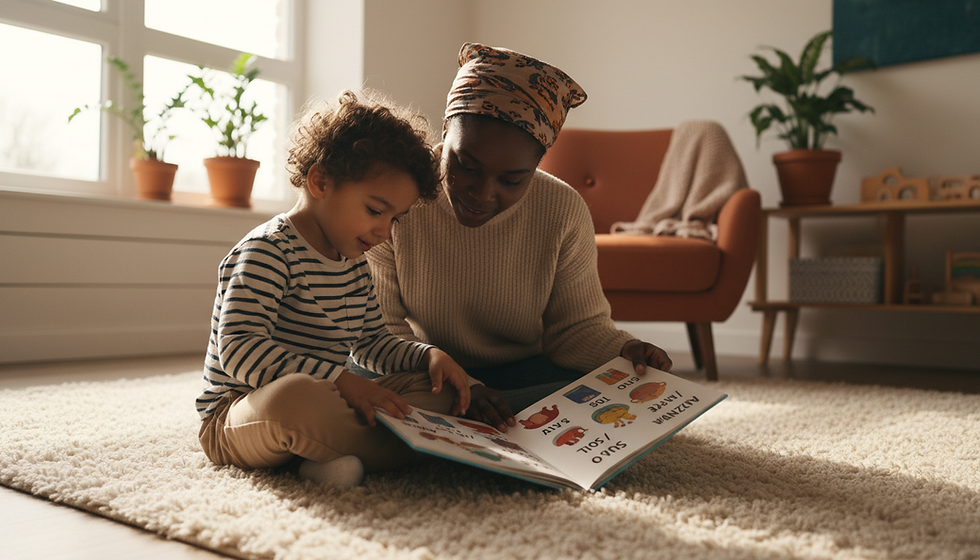
If books are available in the home language, use them often. They do not have to be complicated. Board books, picture books, folk tales, comics, children’s magazines, and simple nonfiction all count.
When reading, pause to talk.
Ask:
“What do you think will happen?”
“Why is the character sad?”
“Have we ever seen something like this?”
“Which page is your favorite?”
“Can you tell this part to me?”
For younger children, pointing and naming is enough. For older children, ask for predictions, opinions, and explanations.
If a book is in English, it can still support the home language. Talk about the pictures in the home language. Translate key parts loosely. Ask questions in the home language. Let the child answer in either language, then model a home-language version.
Tell stories from real life
Family stories are language treasures. They often include words, places, foods, jokes, and values that children may not get anywhere else.
Tell stories about:
When the child was a baby
A family move
A holiday celebration
A funny mistake
A grandparent’s childhood
A favorite meal
A time someone was brave
A place the family loves
Children enjoy hearing the same story many times. Repetition helps them learn the structure and vocabulary. After a few retellings, invite them to help.
“What happened next?”
“What did Grandpa say?”
“Was I happy or scared?”
“Can you tell the funny part?”
These stories build more than vocabulary. They help children see themselves as part of a larger family story. That sense of belonging can become a strong reason to keep using the home language.
Use relatives as language partners
Relatives can give children a real need to use the home language. A short call with a grandparent, cousin, aunt, or uncle can be more meaningful than a long worksheet.
Before a call, help the child prepare a few things to say:
“I lost my tooth.”
“I drew a picture.”
“I learned a new song.”
“We made soup.”
“I want to show you my toy.”
For children who feel shy, start with simple routines. They can wave, sing one song, answer yes or no, or show something to the camera if the call is by video. If it is a regular phone call, they can practice greetings and goodbyes.
After the call, talk about what happened.
“You told Auntie about your drawing. She laughed when you showed the cat. What color was the cat?”
This review helps the child remember the conversation and the words used.
Support English without pushing out the home language
Many parents feel pressure when children start school in English. Homework, reading logs, teacher messages, and peer friendships can make English feel urgent. It is natural to support that. At the same time, English growth does not have to replace the home language.
Children can build both when each language has room to do real work.
Let each language have a purpose
Some families use one-parent-one-language. Some use the home language at home and English outside. Some choose certain routines for each language. Some move flexibly between languages depending on the person, place, or topic.
There is no single best pattern for every family. What helps most is consistency that fits real life.
A family might decide:
Home language during meals
Home language with grandparents
Home language for bedtime stories three nights a week
Home language for cooking
English during school homework
English with neighborhood friends
English library books on weekends
English for sports practice talk
The pattern can change as children grow. The main point is to protect moments where the home language is not an afterthought.
Help with homework through the strongest language
If a child is learning math or science in English, parents can still discuss the idea in the home language. Understanding matters. A child who can explain a concept in the home language often has a stronger base for learning the English terms.
For example, a child working on a life cycle worksheet may need English words like egg, caterpillar, chrysalis, and butterfly. A parent can talk through the idea in the home language first:
“What happens at the beginning?”
“What changes next?”
“Why does the caterpillar eat so much?”
Then the parent can connect the English labels.
This approach tells the child that the home language can handle school ideas too. It is not only for food, chores, and family talk.
Be careful with shame
Some children answer in English even when they understand the home language. Others may feel embarrassed speaking the home language in public. Some may reject it for a while, especially when they want to fit in with peers.
Shame does not build language. Warm boundaries work better.
A parent might say:
“I know English feels easier right now. I’ll keep speaking our language with you because I want you to understand Grandma and our family stories.”
Or:
“You can answer with the words you know. I’ll help with the rest.”
Praise effort, not perfection.
Try saying:
“I understood you.”
“That was a good try.”
“You remembered the word.”
“Let’s say it together.”
“I like hearing you use our language.”
When a child makes a grammar mistake, repeat the sentence correctly in a natural way. Avoid laughing at pronunciation or comparing siblings. Each child’s language path looks different.
Build a simple weekly rhythm that lasts
The best language plan is one a family can keep using. A packed schedule with long activities may look good for one week and disappear the next. Small habits last longer.
Start with routines that already exist, then add language on purpose.
A weekly rhythm could look like this:
Monday Cook one part of dinner together in the home language.
Tuesday Call or send a voice message to a relative.
Wednesday Read one book or tell one family story at bedtime.
Thursday Play pretend store, clinic, or restaurant for 10 minutes.
Friday Sing songs during bath time or clean-up.
Saturday Take a walk and name what you see, hear, and feel.
Sunday Look at family photos and talk about the people and places.
This plan does not require special materials. It only gives the home language a steady place in the week.
Match activities to the child’s age
Babies and toddlers need songs, gestures, simple words, repetition, and warm back-and-forth sounds. They learn from hearing the same loving phrases many times.
Preschoolers need pretend play, picture books, short stories, choices, and chances to describe what they are doing. They enjoy silly language and repeated games.
Early elementary children need longer conversations, explanations, jokes, family stories, simple chapter books, and help connecting home language to school ideas.
Older children may need more choice and respect. They may enjoy music, cooking, movies, family interviews, texting relatives, learning slang or proverbs, or talking about real topics like sports, friendships, hobbies, and plans.
Keep materials easy to reach
Children use language more when the tools are visible and available. A small basket can make a difference.
Fill it with items such as:
Books in the home language
Photo albums
Recipe cards
Puppets or small figures
Paper and crayons
Song lyrics written by hand
Family postcards
Simple games
Rotate items when interest fades. If books in the home language are hard to find, use what is available. English picture books can still spark home-language talk. Family photos can become storybooks. A grocery flyer can become a naming game. A walk outside can become a science lesson.
Celebrate progress in real ways
Progress may sound like a child using one new word. It may look like answering a grandparent without help. It may be singing the first line of a song, asking for a food by its home-language name, or laughing at a joke that only works in that language.
Notice those moments.
A simple comment can strengthen motivation:
“You used that word with Grandpa today. He looked so happy.”
“You told the whole story. I loved hearing it.”
“You remembered the song from last week.”
Children repeat what feels meaningful. When they see that the home language helps them connect, explain, comfort, joke, and belong, they have more reason to keep using it.

A home full of language does not need to be perfect
Bilingual development grows through ordinary moments repeated with care. A child does not need every sentence corrected. A parent does not need to speak like a teacher. The home does not need a strict schedule or expensive materials.
What helps most is steady, meaningful use.
Cook in the home language. Tell stories in it. Laugh in it. Comfort with it. Let children hear it during chores, play, books, walks, meals, and calls with relatives. Let English grow too, without treating the home language as something smaller or less useful.
Start with one routine this week. Choose something that already happens, like breakfast, bath time, a walk, or bedtime. Add more words, more turns, and more warmth. Over time, those small moments become a strong foundation for two languages, and for the family connections carried inside them.


Comments